Yes — PRP can help patellar tendinopathy (jumper’s knee), particularly chronic cases that have not responded to load management and physiotherapy.
Patellar tendinopathy, commonly known as jumper’s knee, causes pain at the front of the knee. The pain sits just below the kneecap. It is particularly common in athletes who jump, sprint, or change direction frequently. It also affects non-athletes who spend long hours on their feet or who have recently increased their activity level. And like most tendon conditions, it can become a chronic, nagging problem that is difficult to shift.
This guide explains patellar tendinopathy and what drives it. It also covers the treatment options available to patients in Sydney’s north-west — including Castle Hill, Norwest, and the Hills District — as well as the Southern Highlands.
What Is the Patellar Tendon?
The patellar tendon connects the kneecap (patella) to the shin bone (tibia). It is the continuation of the quadriceps muscle group and is essential for straightening the knee, walking, running, and jumping. During explosive activities, this tendon absorbs enormous forces — making it vulnerable to overload.
Patellar tendinopathy develops when the cumulative load on the tendon exceeds its capacity to repair and adapt. Rather than an acute injury, it is a gradual process of tendon degeneration. It is characterised by disorganised collagen fibres and increased tendon thickness on imaging. The pain response also becomes sensitised over time.
Symptoms
- Pain directly at the inferior pole (bottom) of the kneecap — often well-localised and reproducible on pressing the area
- Pain that increases with loading activities: jumping, squatting, running, descending stairs
- Stiffness at the start of activity that may ease as you warm up
- Pain that worsens after prolonged sitting with the knee bent
- In chronic cases, pain during everyday activities like walking and climbing stairs
Risk Factors
Patellar tendinopathy is most common in younger active individuals, but can affect anyone. Several factors raise the risk. These include rapid increases in training load and sports involving repeated jumping (basketball, volleyball, athletics). Tight quadriceps and hamstrings, poor movement mechanics, and a history of previous knee injury also contribute.
Conventional Treatment
The evidence-based first-line approach to patellar tendinopathy is progressive tendon loading. This usually means a programme of heavy slow resistance exercise or decline squats, guided by a physiotherapist. This approach works by stimulating tendon remodelling and gradually increasing the tendon’s load tolerance.
Other commonly used treatments include:
- Load management — identifying and reducing the activities that provoke symptoms while maintaining fitness
- Patellar tendon straps or braces — can offload the tendon attachment during activity
- Shockwave therapy — a well-evidenced adjunct for chronic tendinopathy that does not respond to loading alone
- NSAIDs — for short-term pain management only
- Cortisone injection — rarely recommended for patellar tendinopathy; evidence suggests it may provide brief relief but worsens long-term outcomes
Why Patellar Tendinopathy Can Be So Difficult to Resolve
Even with diligent rehabilitation, a proportion of patients with patellar tendinopathy do not achieve full recovery. Some patients still have significant pain and functional limitation after 3–6 months of structured physiotherapy. This is considered refractory tendinopathy, and a different treatment approach is warranted.
The underlying issue is biological. Degenerated tendon tissue heals poorly because of its poor blood supply, disorganised structure, and lack of healthy fibroblastic activity. Treatments that simply reduce symptoms do not fix the underlying tendon pathology.
PRP for Patellar Tendinopathy
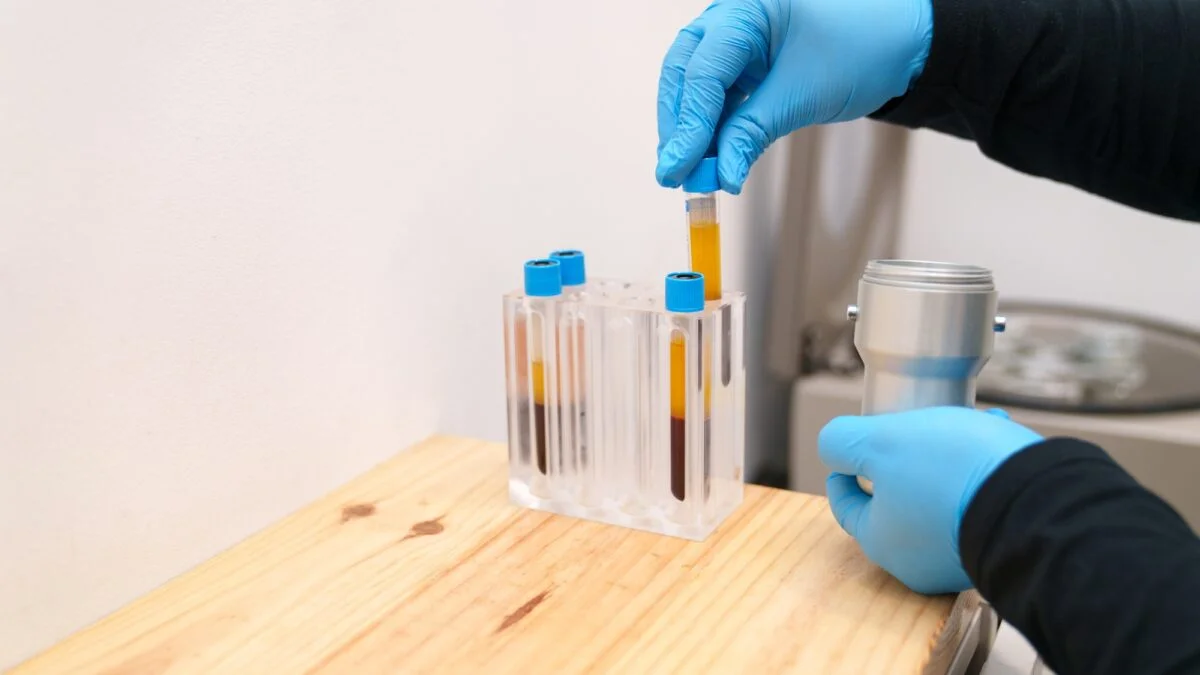
Platelet-Rich Plasma (PRP) therapy offers a biologically targeted approach to chronic patellar tendinopathy. An ultrasound-guided PRP injection places a concentrated preparation of your own growth factors directly into the degenerated area of the patellar tendon. These growth factors — including PDGF and TGF-β — activate the tendon’s own repair cells and stimulate new collagen formation. They also help remodel the abnormal tissue that is driving your pain.
Clinical studies on PRP for patellar tendinopathy have shown significant improvements in pain and function. The benefit is clearest in patients with chronic symptoms who have not responded to conservative care. The results tend to emerge gradually over 6–12 weeks as the tendon remodels, and are more durable than those achieved with cortisone.
PRP is not a replacement for rehabilitation — most patients will continue a loading programme alongside and after their PRP treatment. But it can provide the biological stimulus that helps the tendon to finally respond to the training that wasn’t working before.
Take the Next Step in Your Recovery
Patellar tendon pain can limit your sport, your work, and your quality of life. If physiotherapy hasn’t given you lasting relief, it may be time to explore regenerative options. Dr John PRP provides thorough assessment and PRP treatment for patients across Sydney’s north-west (Castle Hill, Norwest, Baulkham Hills, Kellyville, Pennant Hills) and the Southern Highlands (Bowral, Mittagong, Moss Vale).
Book a consultation today to find out whether PRP is the right next step for your patellar tendinopathy.
For general information on knee pain and tendon conditions, visit Healthdirect Australia’s guide to knee pain.
If you would like to discuss treatment for this condition, learn more about our approach to patellar tendinopathy (jumper’s knee).
Frequently Asked Questions
Can PRP treat patellar tendinopathy?
Yes. PRP can help patellar tendinopathy (jumper’s knee), particularly chronic cases that have not responded to load management and physiotherapy. It uses concentrated platelets from your own blood to support healing in the patellar tendon.
How long does recovery from jumper’s knee take?
Patellar tendinopathy usually improves gradually over several weeks to a few months. A progressive loading and rehabilitation program alongside treatment is important for a lasting result.
How many PRP injections are needed?
Most patients require a course of 2 to 3 PRP injections spaced several weeks apart, though the exact number depends on the severity and chronicity of the tendon problem. Your treatment plan is tailored following assessment.
Do I need a referral to be assessed?
Not usually. If you already have a diagnosis you can often book directly. For more complex cases we may recommend consulting your GP first. We see patients across Sydney’s North-West and the Southern Highlands.