
PRP for arthritis offers an orthobiologic approach to joint pain. It aims to reduce inflammation, which may reduce pain. It is generally considered for mild to moderate osteoarthritis. Explore our knee osteoarthritis treatment page, or review the clinical evidence.
This article explores the role of PRP for osteoarthritis and joint degeneration. It covers how PRP is used, what the evidence says, and whether it could suit you.
Understanding Arthritis and Joint Degeneration
Osteoarthritis is the most common form of arthritis and involves the gradual breakdown of cartilage—the smooth tissue that cushions joints. As cartilage wears away, bones rub together, causing pain, stiffness, inflammation, and reduced range of motion. The condition often affects the knees, hips, shoulders, and hands.
While there is no cure for arthritis, treatments aim to manage symptoms, improve mobility, and slow progression. That’s where PRP therapy comes in.
How PRP Works for Arthritis
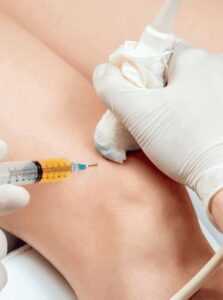
PRP therapy uses your own blood to reduce inflammation within the joint. First, the clinician draws a small blood sample. A centrifuge concentrates the platelets. The clinician then injects them into the arthritic joint under ultrasound guidance. These platelets contain growth factors that aim to reduce inflammation.
PRP delivers a boost of natural growth factors directly into the joint. As a result, it may reduce pain, improve function, and delay the need for surgery in some cases.
Conditions Treated with PRP for Arthritis
PRP for joints can be used in various stages of arthritis and is commonly applied to:
- Knees: knee arthritis PRP is among the most researched and frequently used applications
- Hips: hip pain and early degenerative changes may respond to PRP treatment
- Shoulders: particularly helpful for combined issues such as PRP for shoulder pain and rotator cuff degeneration
- Small joints: such as fingers, wrists, and ankles
Patients with mild to moderate osteoarthritis tend to respond best. Those with advanced bone-on-bone arthritis may see limited benefit, but PRP can still play a role in pain management.
What the Research Says
Recent PRP research studies have shown promising results for managing osteoarthritis symptoms, particularly in the knee. Several clinical trials suggest that PRP may offer better pain relief and functional improvement than cortisone or hyaluronic acid. This advantage appears in certain patient groups.
PRP therapy is not a cure. However, it may help reduce inflammation and improve joint function over time. Patients should not expect instant results, as the response to treatment occurs gradually.
What to Expect During and After PRP Treatment
- Procedure Time: Around 45–60 minutes from blood draw to injection
- Discomfort: Mild post-injection soreness may occur for a few days
- Activity Restrictions: Light activity is encouraged; avoid high-impact exercise for the first week
- Follow-Up: One to three injections may be recommended, depending on the condition
To explore the full process, visit our guide on PRP injection step-by-step.
Are you looking for PRP treatment in Sydney’s north-west or the Southern Highlands? Contact Dr John PRP to arrange a thorough assessment. We see patients from Castle Hill, Norwest, Kellyville, Rouse Hill, Bowral, and Mittagong.
For further reading, visit the research on PRP for arthritis and joint degeneration.
To learn more about our approach, see PRP for chronic joint inflammation.