
Yes — PRP can be an effective option for tennis elbow (lateral epicondylitis) that has become chronic and has not responded to rest, physiotherapy, or bracing.
Tennis elbow — or lateral epicondylitis — is one of the most common overuse injuries seen in orthopaedic practice. Despite its name, the majority of people who develop it have never picked up a tennis racquet. It affects office workers, tradespeople, gardeners, and anyone who performs repetitive gripping or wrist extension activities. And for many people, it simply will not go away without proper treatment.
This guide is for people with tennis elbow in Sydney’s north-west — including Castle Hill, Norwest, and the Hills District — and the Southern Highlands around Bowral. It explains what tennis elbow actually is and why it is so stubborn. It also sets out your treatment options.
What Is Tennis Elbow?
Tennis elbow affects the tendons that attach the forearm extensor muscles to the outside of the elbow. This bony prominence is known as the lateral epicondyle. The key tendon involved is the extensor carpi radialis brevis (ECRB).
Contrary to what the name “epicondylitis” suggests, it is not primarily an inflammatory condition. Research has shown that the underlying problem is tendinosis, a degenerative change in the tendon structure. It involves disorganised collagen fibres and abnormal cellular activity. There is also a lack of normal inflammatory healing response. This is why anti-inflammatory treatments often provide only limited relief.
Symptoms of Tennis Elbow
- Pain and tenderness on the outer side of the elbow, at or just below the bony bump (lateral epicondyle)
- Pain that radiates down the forearm
- Weakness in grip strength — difficulty shaking hands, turning a door handle, or lifting a cup
- Pain with specific movements such as lifting, gripping, or using a keyboard
- Symptoms that have persisted for more than 6–8 weeks despite rest
Why Tennis Elbow Is So Persistent
Tennis elbow frustrates many patients for one main reason. It becomes a chronic degenerative condition rather than a simple injury. The ECRB tendon has a poor blood supply and is under near-constant load during daily activities. As a result, it struggles to heal itself. The degenerative tendon tissue is structurally weak, pain-sensitised, and resistant to the body’s normal repair mechanisms.
Many people spend months — sometimes years — trying rest, bracing, physiotherapy, and cortisone injections with only partial success. While these treatments are appropriate first steps, they do not address the underlying tendon degeneration.
Conventional Treatment Options
- Activity modification and rest — reducing the provocative activity gives the tendon a chance to calm down, but does not fix the underlying degeneration
- Physiotherapy — eccentric and heavy slow resistance exercises for the wrist extensors are the most evidence-backed rehabilitation approach
- Tennis elbow brace / counterforce strap — can reduce pain during activity by offloading the tendon attachment
- NSAIDs — provide short-term pain relief but may actually interfere with tendon healing if used long-term
- Cortisone injections — provide rapid but typically short-lived pain relief; multiple injections are associated with worse long-term outcomes and potential tendon weakening
- Surgery — debridement or release of the degenerated tendon is reserved for refractory cases that have failed 6–12 months of conservative treatment
PRP for Tennis Elbow
Tennis elbow is fundamentally a problem of failed tendon healing rather than ongoing inflammation. For this reason, treatments that stimulate the tendon’s own biological repair process make scientific sense. This is where Platelet-Rich Plasma (PRP) therapy comes in.
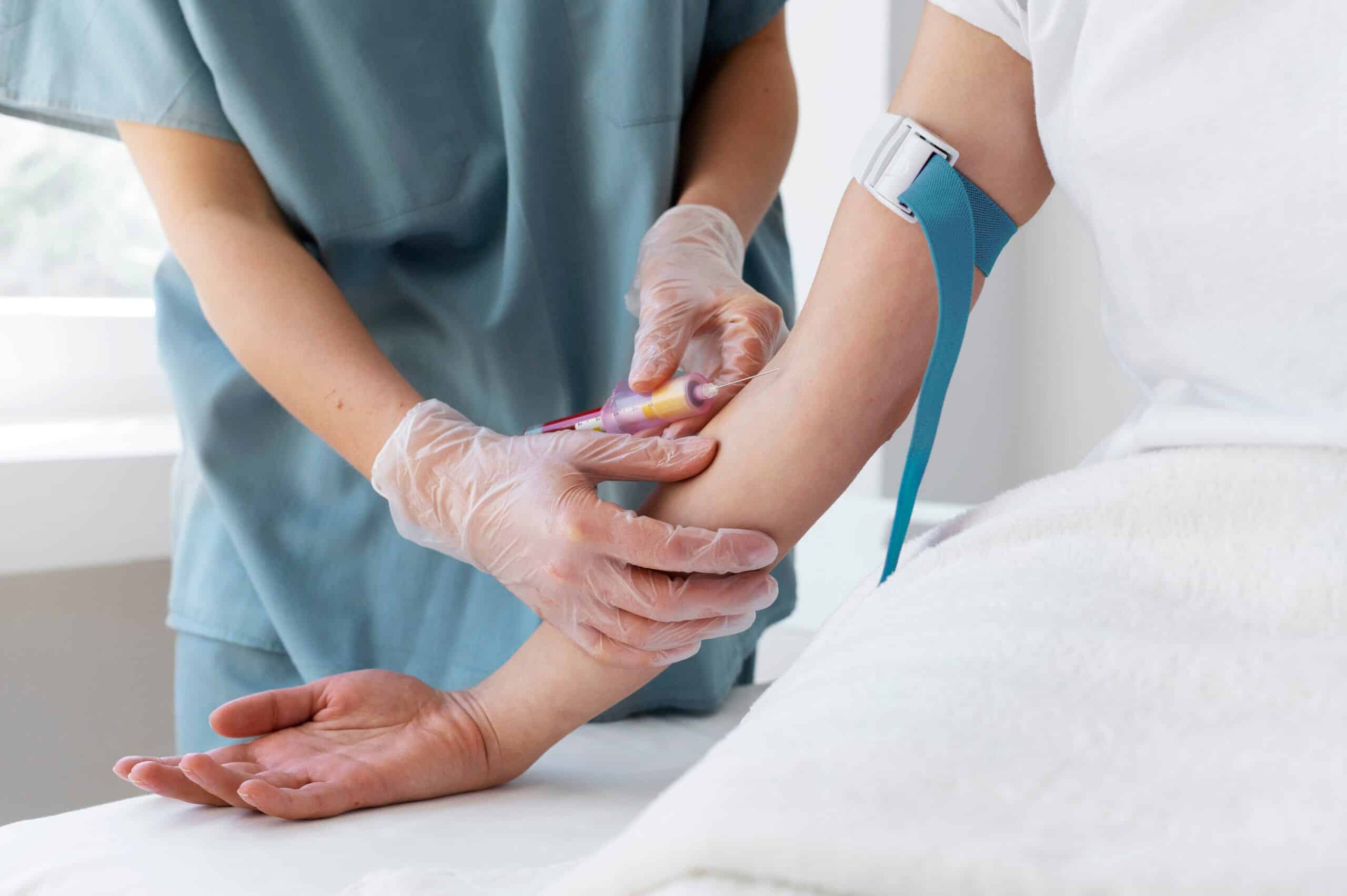
PRP is prepared from a small sample of your own blood, concentrated to increase the platelet count. It is then injected under ultrasound guidance directly into the degenerated area of the tendon. The growth factors released by the platelets include PDGF, TGF-β, and VEGF. They stimulate fibroblast activity and collagen production, and they support the formation of new, healthier tendon tissue.
Tennis elbow is one of the best-studied indications for PRP. Multiple randomised controlled trials and systematic reviews have compared PRP with cortisone for chronic lateral epicondylitis. A single PRP injection produces significantly better long-term outcomes. These benefits are maintained at 1–2 year follow-up. While the initial response may be slower than cortisone, the durability of improvement is considerably better.
Is PRP Right for Your Tennis Elbow?
PRP is best suited to patients with chronic tennis elbow, meaning symptoms lasting more than 3–6 months. It is most appropriate for those who have not achieved lasting relief from physiotherapy and cortisone injections. It is a minimally invasive, low-risk procedure using your own blood, with no systemic side effects.
At Dr John PRP, we use ultrasound-guided injection technique to ensure accurate placement and optimal results. We work with patients from across Sydney’s north-west including Castle Hill, Norwest, Kellyville, and Baulkham Hills, and from the Southern Highlands including Bowral and Mittagong.
If tennis elbow has been holding you back, book a consultation to discuss whether PRP is appropriate for your situation.
For further information, see Healthdirect Australia’s guide to tennis elbow.
If you would like to discuss treatment for this condition, learn more about our approach to tennis elbow (lateral epicondylitis).
Frequently Asked Questions
Can PRP treat tennis elbow?
Yes. PRP can be an effective option for tennis elbow (lateral epicondylitis), particularly when the condition has become chronic and has not responded to rest, physiotherapy, or bracing. It uses concentrated platelets from your own blood to support healing at the outer elbow.
Why does tennis elbow persist for so long?
Tennis elbow persists because the affected tendon has limited blood supply and often does not heal well with rest alone, especially with ongoing loading. Regenerative approaches such as PRP aim to stimulate a healing response in the tendon.
How many PRP injections are needed for tennis elbow?
Most patients require a course of 2 to 3 PRP injections spaced several weeks apart, though the exact number depends on the severity and chronicity of the tendon problem. Your treatment plan is tailored following assessment.
Do I need a referral to be assessed for tennis elbow?
Not usually. If you already have a diagnosis you can often book directly. For more complex cases we may recommend consulting your GP first. We see patients across Sydney’s North-West and the Southern Highlands.