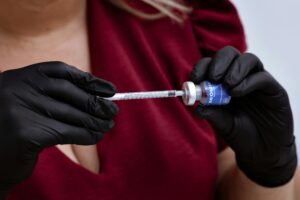
Dr John PRP offers two injection treatments in Bowral and at Norwest: PRP on its own, and PRP combined with hyaluronic acid (HA). Both aim to reduce inflammation, leading to pain reduction. This article explains how they differ and which is generally used for which condition.
The short version
| PRP | PRP + HA | |
|---|---|---|
| What it is | Platelets concentrated from your own blood | PRP combined with hyaluronic acid in a single injection |
| Most often used for | Tendon conditions such as tennis elbow, golfer’s elbow, rotator cuff, Achilles, patellar and gluteal tendinopathy | Joint conditions such as knee osteoarthritis, meniscal problems and post-surgical joint pain |
| Usual course | 2–3 sessions, 2–4 weeks apart | 2 sessions, 4 weeks apart |
| Fee per session | $550 | $750 |
PRP on its own
PRP (platelet-rich plasma) is prepared from a small sample of your own blood. The sample is spun in a centrifuge to concentrate the platelets, and the PRP is injected into the affected area, using ultrasound guidance where needed.
At Dr John PRP, PRP on its own is most often used for chronic tendon problems that have not settled with a structured loading program or physiotherapy. Examples include tennis elbow, rotator cuff tendinopathy, Achilles tendinopathy and gluteal tendinopathy.
PRP + HA
Hyaluronic acid is a gel-like substance that occurs naturally in joint fluid. In a PRP + HA treatment, PRP and HA are combined and given as one injection into the joint. PRP + HA aims to reduce inflammation in the joint, leading to pain reduction.
It is most often used for knee osteoarthritis, and may also be considered for meniscal problems and persistent joint pain after surgery.
How the choice is made
The choice is made at your consultation, after Dr John has taken a history, examined the area and reviewed your imaging. In general:
- a problem in a tendon is usually treated with PRP
- a problem inside a joint, particularly the knee, is usually treated with PRP + HA
Sometimes neither is appropriate. For example, bone-on-bone (Grade 4) knee arthritis, complete tendon or ligament tears and active infection are generally not suitable, and Dr John will tell you if another pathway, including a surgical opinion, makes more sense.
What both treatments have in common
- Both are prepared from your own blood on the day.
- Both aim to reduce inflammation, leading to pain reduction. For some patients this may help to avoid surgery.
- Improvement is usually gradual over several weeks, and rehabilitation remains an important part of recovery.
- Results vary between individuals, and some people do not improve.
- Neither is covered by Medicare or private health insurance.
Dr John does not offer injections for the spine, back, neck or sacroiliac joint, or for plantar fasciitis.
Fees
The initial consultation is $270. PRP treatment is $550 per session and PRP + HA treatment is $750 per session.
Booking
Dr John consults at The Bowral Doctor, 2 Gordon Road, Bowral, for patients across the Southern Highlands, and at Norwest Private Hospital in Bella Vista. You do not usually need a referral. Book an appointment online or call 02 8231 6529.
This article is general information only and is not a substitute for individual medical advice. Results vary between individuals.